Showing posts with label Olympus E-P2. Show all posts

Saturday, March 3, 2012

New gear

A desire to start doing some more serious video work has slowly grown stronger. Finally I took the plunge and bought one of the best video capable interchangeable lens cameras, the Panasonic GH2. This camera uses the same m43 system as my Olympus E-P2 camera, meaning that all the lenses can be used on both cameras. I ordered the kit with the 14-42 lens, which actually was only marginally more expensive than just the camera body, to a local shop, Kamera-Aitta. It was a little more expensive than it would have been from a German internet store, but I am willing to pay a little more to get it locally.

Parallell to this I streamlined my existing system a little, due to some ridiculous rebates at another local camera store, Rajala Pro Shop. I sold some existing lenses and the Olympus E-P2 body, since I can't afford and don't want to have stuff I don't use.

The net result of this is seen in the following picture:


The E-PL1 is a cheaper version of the E-P2, which I sold. It has fewer controls, a slightly less advanced image stabilizer and a fastest shutter speed of 1/2000s. The image quality should theoretically be slightly better: It has the same sensor, but a weaker AA-filter that should help resolving a little more detail. I doubt I will be able to notice any difference, though. Somewhat surprisingly, the E-PL1 does have a small internal flash that can be used to trigger external Olympus flashes, giving full wireless TTL control over several external flashes. I tried it and it really does work. This camera should be a good second camera body to have.

I had contemplated the Panasonic GH2 for some time, but wanted to see how the new Olympus m43 flagship, the OM-D E-M5, would turn out. The E-M5 is a very interesting camera, with most features better or at least equally good as those of the GH2. According to the first reports, the E-M5 has an exceptionally good image stabilizer that works wonders for videos as well. Unfortunately, the video capabilities of th E-M5 are otherwise no match for the GH2, so I ultimately decided to get the GH2. It has the best sensor of the current m43 cameras (the performance of the E-M5 sensor is still undetermined) and is especially good for videos. The GH2 offers a lot of functionality and it will take some time to learn it to get the most out of it. There is even a bunch of hacks for the GH2, which improve the video quality quite a bit. I tested out a simple and well supported version to get a higher bitrate, which translates to more details when a lot happens in the picture, and high ISO in manual video mode. ISO 8000 did seem quite usable for video, at least when using the maximum  noise reduction setting. A lot to learn and test out.

These two cameras and the lenses all follow the m43 standard, and hence all the lenses are compatible with both cameras. I will probably not bring the entire system at the same time, unless explicitly doing a photography excursion.

In addition to the cameras above, I still have the Canon S90 pocket camera. It gives good image quality in a truly pocketable format and has a bright lens with a maximum aperture of 2.0, so it is quite usable when the sun isn't shining as well. I also have the CHDK software for the S90 and intend to use it for some time-lapse photography.

Sunday, January 22, 2012

Utö

Time for a pure photography excursion. BioFoto Finland held the year meeting at Utö. This was the first visit to Utö for me, though I technically had set my foot on the island once before, when the ferry spent the night there in shelter for a hard January storm before finally going to Jurmo. Utö is a place visited mostly by photography and bird enthusiasts, at least outside the summer season. The place became more accessible some five years ago when the military left the island.

You get to Utö with a ferry from Pärnäs/Pärnäinen and the journey takes a little under five hours. Our group, consisting of almost twenty persons, met at the ferry on Friday evening. We arrived at 22:40 in the evening at Utö Havshotell, an old military barrack converted to a hotel of a good standard. A totally different accomodation than on my usual outings.

After a good nights sleep, the morning looked quite promising, despite the rather depressing weather forecast. A quick glimpse outside the hotel before the breakfast buffet showed the following view.


The morning colors were perfectly acceptable.


The Utö lighthouse...


... and a previous version?


While the military no longer have an active presence on the island, it is an important base for the coastal pilots and the coast guard, hence the radar surveillance.


I was not the only one out photographing.


Some morning pictures.


After some time the sun disappeared behind the clouds, changing the light.


A poor gull had lost its feathers (and life).


The small chapel on the island.


The lighthouse again.


We even got to see the inside of the lighthouse. It has a small ballroom and even a small chapel, available for weddings.


Occasional ice patches.


After lunch the weather changed and it started to snow a little. When we arrived there was no snow on the island, but now the ground got a thin cover of snow.


The small village. There is probably a between ten and twenty permanent residents, with a lot more people living there in the summer.


Port lateral mark.


The waters around Utö have always been dangerous for mariners, and there are lots of ship wrecks there. This is a memorial for SS Park Victory, which sank during a storm in 1947.


Changing light.


Another view.


Nature first.


Another house.


The harbor.


This is how the coastal pilots get out to the ships they are to assist. In all possible weather conditions.


The sun set behind the clouds at 16:20. It had been an interesting day with quite varying weather. The morning temperature was a little below freezing and there was no wind. Later the temperature rose a little and there was some wind. It was also snowing for a short while.

The following morning was cloudy and windy, with a less inspiring light, but there was still something to photograph.


Exposed and windy.


A Mute Swan enjoying the wind. Or not.


Our transport home, M/S Eivor, formerly Baldur from Iceland. There was plenty of time to go through the pictures and write this on the way home.


Since this was my first visit to Utö, there are a bunch of ordinary tourist pictures, but hopefully a few pictures still rise above that category.

I used my newish lightweight photo gear and did not feel restricted by it, but a longer tele would possibly have enabled some bird shots. The others all had very serious camera gear, but I have made my choice and strive to make the most of it. This time I did have my old heavy Manfrotto 055C tripod with me, since I thought a lighter tripod would not have been able to handle the wind. On the Sunday morning in the hard wind I also think a heavier camera would been more stable in the wind. The Olympus E-P2 with the 40-150 lens felt like the wind caused some high frequency vibration on it when mounted on the tripod.

Sunday, December 25, 2011

Flash

I'm an available light photographer foremost. The newer digital cameras allow you to take photographs in many situations, also indoors, without a flash if you have fast (=big aperture) optics. Still, I bought a small flash for my Olympus E-P2 as an early Christmas gift for myself. The Olympus FL-300R is a small flash made for the new PEN cameras. The built-in wireless functionality does not work with my E-P2 camera, though, but I ordered a cheap long TTL cable to test some fill flash for my bike photography. The TTL cable, which haven't arrived yet, is needed to get it away from the optical axis, in order to avoid the hard and ugly flash light which plagues most of the flash pictures you see.

The first test for indoor photography went fine. The flash is (just) strong enough to be bounced via the ceiling to give a more natural looking light. Combining it with e.g. the Panasonic 20/1.7 lens and a suitable long exposure times enables getting a good balance between the indirect flash light and the ambient lights.

I also brought the flash with me on an overnighter with the bike to test out some slow-sync flash pictures. In these situations the flash should be set to fire when the second curtain of the shutter closes, to get the light trails to end with the flash instead of to begin with it.


One test showed a funny side effect of the helmet light on half power. Since this particular Led light is dimmed by PWM (the light is pulsed) the light trail looks funny. It shows that the light is not on all the time.


Another funny effect was when the fairly strong lights burned out the foreground before the bike arrive at the place where the flash fired, causing the wheels to partially disappear from the picture.


Finally, the following picture shows what happens when the flash synhronizes on the first curtain instead of the second. The effect is not particularly visible on this picture, but one can still see the the bike and ride have moved slightly after the flash fired. In this case the effect actually brought a little more movement to the picture, but usually second curtain synchronization works better for this purpose.


The last picture is closest to what I envisioned using a fill flash for. There are lots of situations in the forest where it is too dark to get a fast enough shutter time to freeze the action. By using a shutter time e.g. between 1/15 s and 1/50 s the surroundings would be correctly exposed and a flash fired towards the bike rider would render a sharp image of the rider as well. The possible unsharpness of the rider that comes from the long exposure time is much weaker and only contributes to the feeling of movement. More experiments ahead...

Sunday, December 18, 2011

Darkness

Here we are, three days before the winter solstice, and the miserable fall just continues. Outside it is 4°C, raining and dark. Not what you would expect at this time of the year. While we might not always have winter by now, we should at least have some signs of it. Instead the long, grey and rainy fall just continues.

Last weekend I went on a short overnighter to take advantage of the forecasted übermiserable weather, but the weather wasn't that bad after all. I took the opportunity to check the Olympus E-P2 video performance in the darkness. With a maximum ISO in video mode of 1600 ISO it has its limitations, since the longest shutter speed possible is 1/30s when doing videos. In practice the kit lens or any other of my zoom lenses would be just on the limit, but the Panasonic 20/1.7 lenses has an advantage of 2-3 stops, so it was quite usable even without going to the highest possible ISO. I also used an additional light as seen in the following short video:


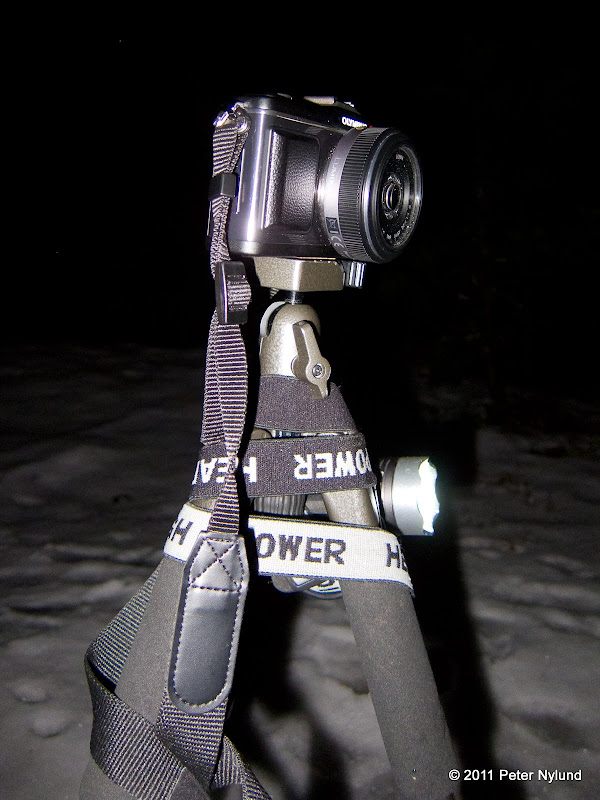
The extra light was simply a bike light (nominally some 1200 lumen with maybe 800 real lumen) fastened to the tripod.


The moon even showed itself that night, giving a fairly interesting light.


The actual video is still not ready, since I have yet to find music for it. Finding suitable royalty free music is time consuming, as I don't feel like paying much for it. Jamendo does have something as well as Kevin MacLeod, but it is still difficult to find music of the right lenght and mood. This is one of the things preventing me from getting one of the new cool GoPro Hero2 HD cameras. A GoPro would enable some interesting footage, though.

Sunday, November 27, 2011

Sun

Yesterday the usual November greyness gave way to a more inspiring weather. The days are quite short (sunrise at 8:58 and sunset at 15:38), but clear weather gives more than one hour of extra light compared to the rainy greyness.

Typical colors for the time before we get snow and have some occasional sunny days.


The long and warm fall has some plants confused. In this photo I lifted the exposure slightly and pulled down the darkest color in Lightroom. Simple and effective.


Same trick on this photo as well a some additional vignetting.


Around sunset the weather seemed unusually clear, but by the time I had eaten dinner and enjoyed my excellent French roast coffee a slight haze had come in and there was no point in doing any more serious night sky photography. The lights from the city pollute the sky too much for that. I still walked a few hundred meters from my home to get away from the lights to test a new night sky focusing tehcnique I read about: There is a setting in the camera that resets the lens to infinity focus when powering down. As I expected, the lens did not focus accurately to infinity. The only option is manual focus against a suitably bright star or planet. Jupiter was too bright and it was hard to judge when it was sharp. The focusing consist of making a dot as small as possible and with Jupiter the range in which the dot was small and sharp was unnecessarily big. Dimmer stars on the other hand are not visible. Fortunately, the sky is full of stars and planets of different brightness.